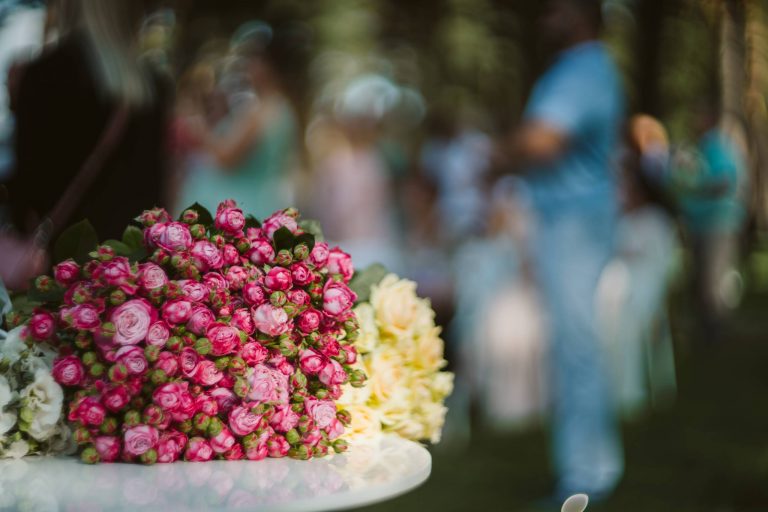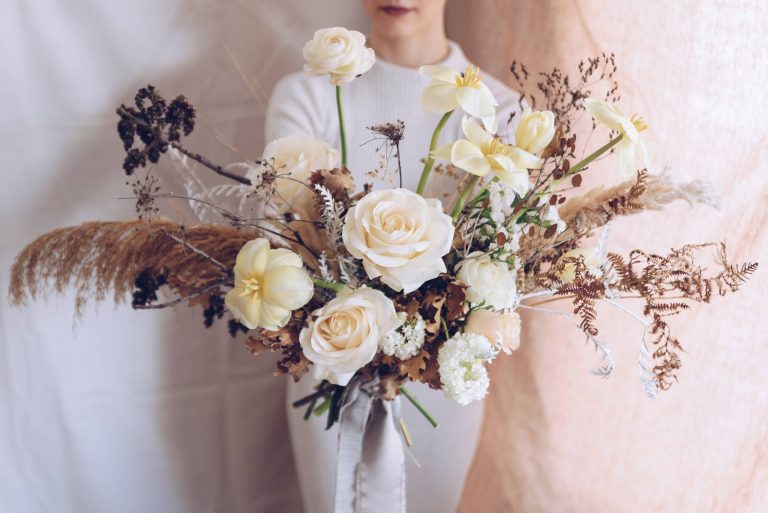
One of the first things that draws attention in a wedding bouquet is texture. Color and shape come later. I think we use texture in flowers to add some visual interest to our designs and to create a way to add depth to an otherwise flat photograph. For example, pairing roses (which are classically pretty and romantic, but very smooth) with the soft, lacy plumes of astilbe or the snap of veronica, or the soft, fuzzy leaves of dusty miller adds visual interest to the design. When all the flowers in a bouquet or centerpiece are smooth, the overall effect can be flat.
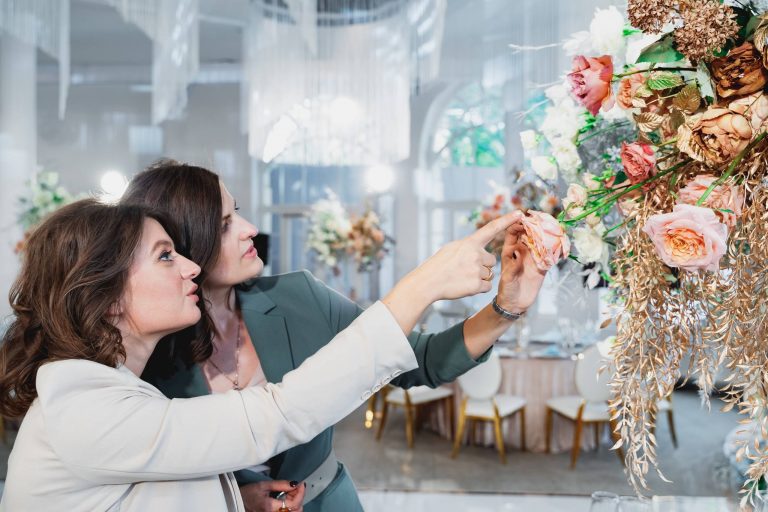
Flow is another important principle that infuses life into the piece. There’s a reason why the bride walks down the aisle and not the other way around. The direction of the flow in a piece tells the eye where to go, and how to move around the arrangement. Amaranthus trails down, jasmine trails down, scabiosa trails down. This helps to soften architecture, and bring movement into structures like arches, chandeliers, or waterfalls. On a table, you can have a sense of flow by running a series of long-stemmed calla lilies from one end to the other, or using sweeping greens. You can also create flow in a rounded, curvilinear shape like in looped ivy, or twisting sweet peas. But what creates a sense of movement is not having the elements be perfectly rounded, rather, letting some of them trail a bit beyond the body of the arrangement, and others retreat.
Texture and motion should be balanced. Too many textures can make an arrangement feel chaotic. Often one texture, such as the ruffles of a peony, will be the focus of an arrangement. Then smaller elements of other textures will be added to enhance it. Motion can be enhanced with lighting. Darker shadows created behind leafy greens add depth. But the feathery aspect of Queen Anne’s lace is more pronounced when lit from behind. The airy texture of baby’s breath appears as a glowing cloud with backlighting. If an element will be suspended or trailing it’s nice to pair it with something stationary. These are things a designer will learn with time, noting what feels calming and what feels energetic and what works with any wedding theme.
How it is carried out can also enhance these principles, especially when dealing with bigger items that need strength to hold the design. Wiring allows for trailing flowers to be added without any mechanical fastenings, and anchoring flowers that have weight to the bottom of a piece keeps it stable and makes it more difficult for it to fall over. Hydration is important to keep airier foliage and wavy flowers fresh and hydrated, especially in pieces that may be in use for several hours. Incorporating non-traditional items like feathers, seed pods, or dried flowers can add a level of creativity and interest to a design as long as they do not compromise the natural beauty of the flowers. Incorporating special items like these can help to make the flowers from a wedding truly personal.
Last but not least, texture and movement are the subtle storytellers of wedding flowers. Both convey a sense of purpose, sentiment and craftsmanship without uttering a word. They beckon the eye to pause and observe, to appreciate the thought that has gone into every petal and frond. Used effectively, they guarantee that the flowers aren’t simply dressing the space but are integral to its emotional atmosphere and the unfolding drama of the wedding day, from introspective expectation to exuberant triumph, an experience that will be remembered long after the last waltz. As our art form evolves, I predict there will be even more innovations in this area to come!